
The UK office market is undergoing one of its most significant structural shifts in a generation. What began as a pandemic-era experiment in remote working has matured into a permanent recalibration of how, where, and why businesses use physical flexible workspaces.
The numbers tell a compelling story: the UK flexible office market is now valued at an estimated $4.19 billion in 2026, growing at over 9% annually, with regional cities such as Manchester, Birmingham, and Leeds reporting annual flex-space growth of more than 18%.
For commercial property owners, it has moved well beyond a passing trend. Instead, it represents a fundamental change in the way office assets are valued, fitted out, and operated. And critically, it creates substantial, and often overlooked, opportunities for Capital Allowance claims.
A Permanent Operating Model
Hybrid working has become central to how modern businesses operate. The April 2024 “day-one” flexible working legislation gave employees the right to request flexible arrangements from their first day in a role, formalising what many employers had already adopted in practice. The result is a commercial property landscape in which the traditional long-lease, single-tenant office model is giving way to something far more dynamic.
Flexible workspace provider Orega, which celebrates its 25th anniversary this year, reflects the evolution well. CEO Alan Pepper has noted that flexible workspaces has moved from being a “nice to have” to a core component of how businesses function. Orega has opened eight new premium centres in the past two and a half years and plans to expand to 45 locations within five years, evidence that institutional confidence in the flexible model is growing, not retreating.
This pattern extends well beyond any single operator. Major groups, Landsec, British Land, Canary Wharf Group, and Great Portland Estates, have all launched dedicated flexible workspaces of their own. These are not experiments. They are fully resourced operations with serious investment behind them, and they are attracting the kind of corporate occupiers who previously would have signed traditional ten-year leases without question.
Regional Cities Leading the Charge
While London remains the UK’s largest flexible workspace market with over 1,400 locations, the most dynamic growth is happening outside the capital. Manchester hosts 128 flexible workspace locations, Glasgow 68, Birmingham 66, Bristol 61, and Leeds 60. Scotland as a region is expected to grow at nearly 11% annually through 2031.
Bristol offers a particularly striking case study. The West of England economy is growing at four times the national average, generating over £54 billion annually, and the city maintains the highest rate of net business start-ups outside London. That economic momentum is driving sustained demand for high-quality, flexible office space from professional services, technology, and financial firms.
Across these regional markets, the UK now hosts more than 4,150 flexible workspace locations — a figure that underscores just how deeply the model has embedded itself into mainstream commercial property. Corporates now represent 47% of global flexible workspaces occupancy, up from just 13% in 2020. The flexible workspace is no longer the domain of freelancers and start-ups; it is standard corporate real estate strategy.
A New Generation of Plant and Machinery
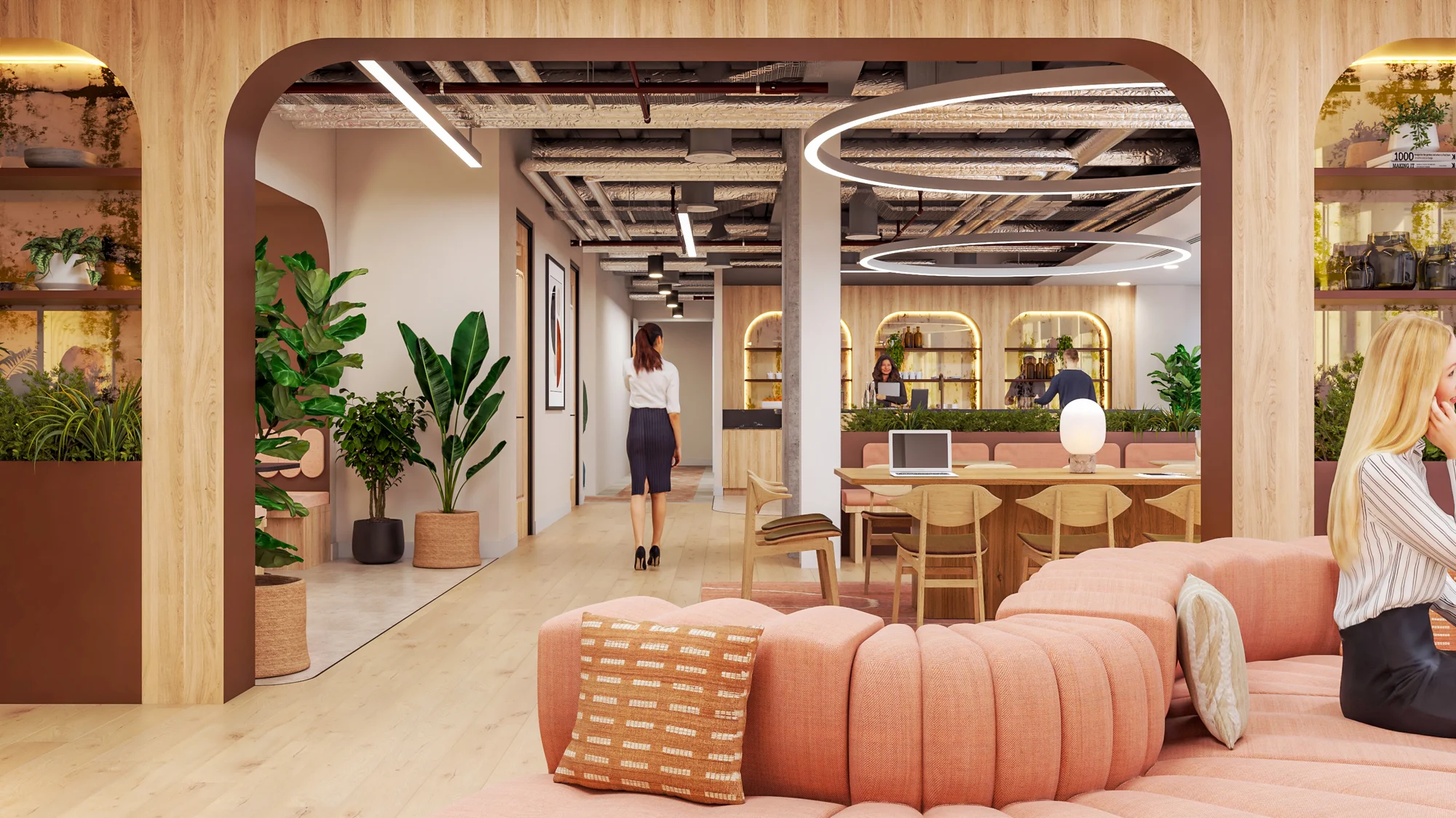
The modern flexible office is a far more complex asset than its traditional predecessor. Where a conventional office might contain basic lighting, standard HVAC, and simple cabling, today’s flexible workspaces are equipped with sophisticated building management systems, high-specification air conditioning and ventilation, advanced electrical and data infrastructure, specialist lighting controls, acoustic treatment, automated access and security systems, wellness amenities, and technology-enabled booking and occupancy platforms.
Each of these elements represents qualifying plant and machinery expenditure that can be claimed as Capital Allowances.
The scale of fit-out investment in this sector is substantial. Operators and landlords are pouring capital into creating environments that foster collaboration, support wellbeing, and reflect a company’s brand and ambition. Sustainability certifications such as BREEAM and WELL are increasingly standard, often requiring significant investment in energy-efficient systems, renewable integration, and specialist building services — all of which can qualify for relief.
On average, HMA Tax identifies around 25% of a commercial office property’s purchase price in previously unclaimed Capital Allowances. For a £400,000 property, that could mean £100,000 in identified allowances — translating to a £40,000 tax refund or reduction for a higher-rate taxpayer.
Refurbishment Cycles Are Accelerating
The flexible workspace model also accelerates the refurbishment cycle. Traditional offices might see a major refit every ten to fifteen years. Flexible workspace operators, competing for occupiers on the strength of their environment and amenities, are investing in upgrades far more frequently. Each refurbishment creates a fresh wave of qualifying expenditure, new HVAC systems, upgraded electrical infrastructure, reconfigured lighting, and enhanced digital connectivity.
For property owners who have converted or refitted office space for flexible use, the Capital Allowance implications are significant. Many businesses mistakenly treat refurbishment costs as purely non-claimable capital expenditure. In reality, even decorative enhancements and updates to integral systems can qualify for relief. Retrospective claims are also frequently possible, meaning property owners who have already completed fit-outs can still recover unclaimed allowances.
The current Capital Allowance framework continues to support investment in commercial property. Full Expensing, made permanent at the 2023 Autumn Statement, allows companies to deduct 100% of qualifying plant and machinery expenditure in the year it is incurred. Following the Autumn Budget 2025, a new 40% First-Year Allowance is available for special rate pool assets, while the main Writing Down Allowance rate has been adjusted from 18% to 14%.
These legislative changes make it more important than ever for property owners to ensure their claims are accurate, comprehensive, and submitted correctly. The interaction between different allowance types, the classification of assets between main rate and special rate pools, and the treatment of integral features all require specialist expertise to navigate properly.
Why Property Owners Continue to Miss Out
Despite the scale of the opportunity, Capital Allowances remain one of the most underutilised areas of tax relief in UK commercial property. The reasons are well documented: it is a highly specialised area of tax statute that sits outside the scope of most general accountancy practices. Identifying embedded allowances requires detailed surveying, valuation, and legislative expertise — skills that most accounting firms simply do not hold in-house.
In the context of flexible workspaces, the claims are becoming larger and more complex. The sheer volume of qualifying plant and machinery in a modern flexible office — from automated climate control and smart lighting to security systems and data infrastructure — means that the gap between what owners claim and what they are entitled to can be substantial.
The flexible workspace sector’s trajectory is clear. Nearly 30% of all office space is expected to be flexible by 2030. Operators are expanding, landlords are adapting, and corporate occupiers are embedding flex into their long-term real estate strategies. For those who own, acquire, or refurbish office property to meet this demand, the Capital Allowance opportunity is growing in parallel.
At HMA Tax, we have completed over 8,500 claims with a 100% HMRC approval rate, identifying more than £750 million in allowances for UK commercial property owners. Our specialist in-house team of chartered surveyors and tax advisors works exclusively in this area, providing the detailed analysis and compliance expertise that complex office claims demand.
If you own or have recently invested in commercial office space, whether traditional, flexible, or mixed-use, your property is very likely holding thousands of pounds in unclaimed Capital Allowances. Our service operates on a results-only basis: if we do not identify allowances that are approved by HMRC, there is no fee.
Estimate Your Capital Allowance Claim
Use our free online calculator to see what your property could be worth in unclaimed relief.Or call our team: 01384 904090 | contact@hma.tax
HMA Taxis the UK’s leading Capital Allowance specialist, with offices in the UK, Singapore, and Australia. Part of the K3 Capital Group.