

UK commercial real estate attracted £10.2bn of investment in the second quarter of 2026, 20% below Q1. Across the rolling twelve months, £66.7bn transacted — 18% ahead of the year to Q2 2025. A softer quarter within a stronger year, and 305 completions now carrying a two-year statutory deadline for securing the Capital Allowances held within each building.
Q2 2026 figures place quarterly volumes at £10.2bn against £66.7bn on a rolling annual basis. A quarter-on-quarter fall alongside year-on-year growth points to transaction timing rather than a change in direction.
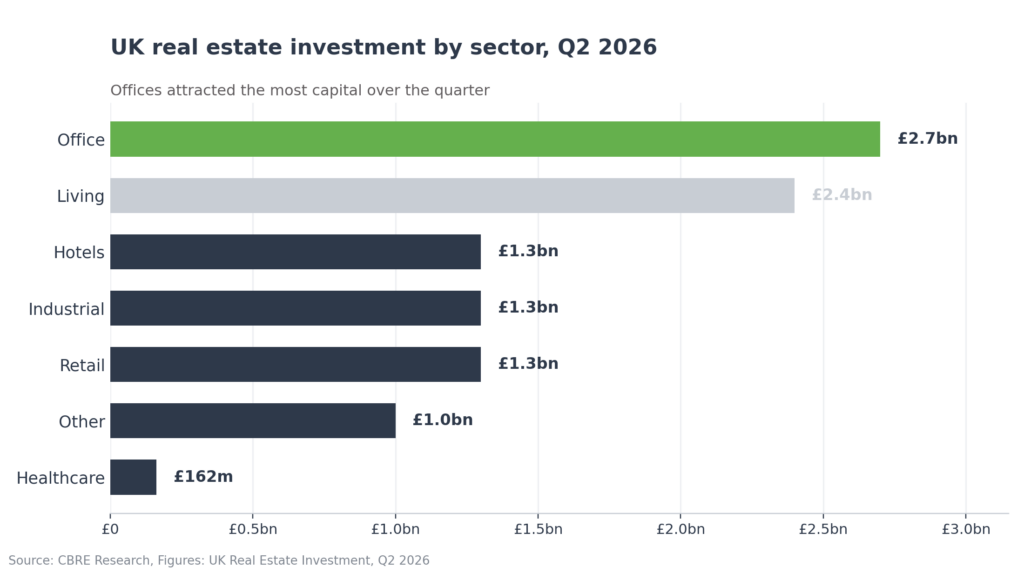
Offices attracted the most capital over the quarter at £2.7bn, ahead of the Living sector at £2.4bn, and were the only sector to record a quarter-on-quarter increase. Hotels, Industrial and Retail each transacted £1.3bn.
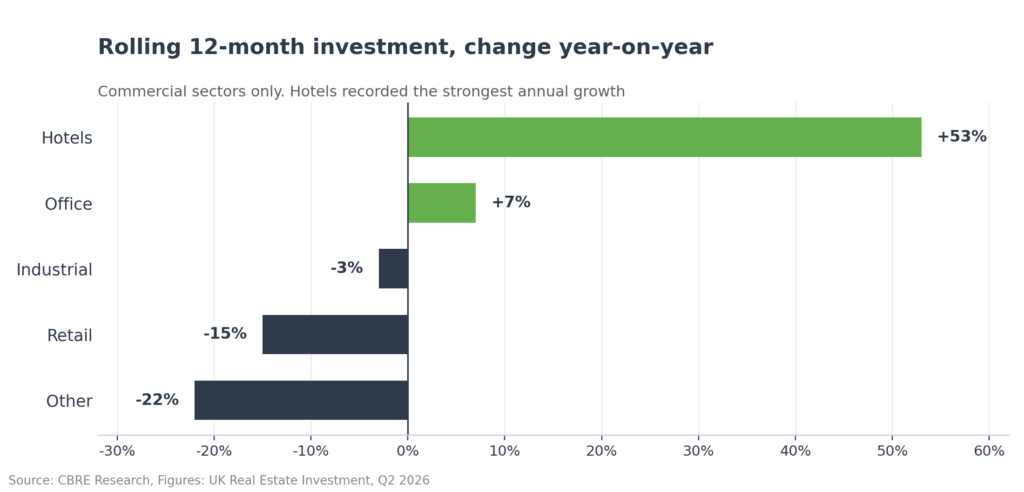
The rolling annual picture separates the commercial sectors more clearly. Offices stand at £11.1bn over twelve months, up 7% year-on-year. Hotels reached £6.0bn, up 53% — the strongest annual growth of any commercial real estate sector. Industrial and Retail moved in the opposite direction.
Domestic investors deployed £5.2bn over the quarter. Across the first half the split was close to even, at 51% domestic and 49% foreign. North American buyers led foreign investment with £4.0bn of UK real estate in H1, followed by European investors at £1.7bn.
Impact on Capital Allowances
Across £10.2bn in transactions, each carries its own fixtures history, its own vendor pooling position, and its own two-year deadline running from its own completion date.
Across all qualifying commercial real estate asset classes, an average of 27.5% of a commercial property’s purchase price is recoverable in Capital Allowances at the point of acquisition.
Applied across a quarter of this composition, the relief held inside those completions is substantial, and a meaningful proportion of it will remain unclaimed. That follows directly from the way the fixtures legislation operates.
The two-year rule
Where a previous owner was entitled to claim allowances on the fixtures within a building, a buyer’s ability to claim depends on two statutory conditions under the Capital Allowances Act 2001.
The pooling requirement obliges the seller to bring the qualifying expenditure into their capital allowances pool before the sale. The fixed value requirement (s.187A) obliges both parties to fix the transfer value of those fixtures, normally through a s.198 election, within two years of completion.
Where either condition goes unmet, the allowances are extinguished permanently — for the buyer, and for every subsequent owner of that building.
For deals completing in Q2 2026, that deadline falls in Q2 2028. In practice the position is most easily resolved early. By the second year-end the vendor has usually moved on and the transaction records are harder to reconstruct, and a negotiation that takes a week at the point of sale can take six months afterwards.
Value concentration
Two features of this quarter sharpen the point.
Hotels recorded the strongest annual growth of any commercial sector, at £6.0bn over twelve months and up 53% year-on-year. Hotels are among the most fixture-dense asset classes in the market: mechanical and electrical installations, kitchens and back-of-house plant, lifts, air conditioning, sanitaryware, and specialist fit-out throughout. Across our hotel casework, around 32% of purchase price typically qualifies — comfortably above the 27.5% commercial average. Growth in this sector puts more recoverable value into play per pound transacted than almost anywhere else.
Offices led the quarter and grew 7% on the year. Integral features carry much of the qualifying content in an office acquisition — electrical and lighting systems, cold water systems, heating and ventilation, lifts — and this content is routinely absorbed into a headline purchase price without separate identification.
Foreign capital accounted for 49% of investment across the first half. The UK fixtures regime is unusual internationally, and investors arriving from jurisdictions with different depreciation rules regularly complete on UK assets before a s.198 election is agreed in the SPA, or before the vendor’s pooling position is confirmed. On cross-border transactions, UK advisers on both sides are best placed to raise it ahead of exchange.
UK property returns in the first half of 2026 were income-led: total returns of 2.5%, with income returns of 2.8%. Prime yields across most sectors now sit within 25 basis points of their ten-year highs, and lending conditions have improved.
In a market where returns are being worked for rather than handed over, the relief already held inside an asset is one of the more predictable contributions an owner can make to their net position, provided it is identified within the statutory window.
HMA Tax has completed over 9,500 Capital Allowances claims with a 100% HMRC approval rate, identifying more than £750m in relief for UK property owners. If you have acquired commercial property in the last two years and are unsure whether allowances were secured, we can review the position at no cost.
Market data provided by CBRE Research (2026)